Culture
Red pill or blue pill: what the choice in The Matrix actually means
Two pills, one open palm each. The scene lasts about a minute, and it gave everyday English a shorthand for choosing what is true over what is comfortable.
7 min read
Short answer
In The Matrix (1999), Morpheus offers Neo two pills: the red pill is the uncomfortable truth and the blue pill the comfortable illusion. In everyday English, taking the red pill means choosing to see something as it really is, at some cost to your peace of mind, and taking the blue pill means choosing not to look. Neither promises happiness; only the red one promises accuracy.
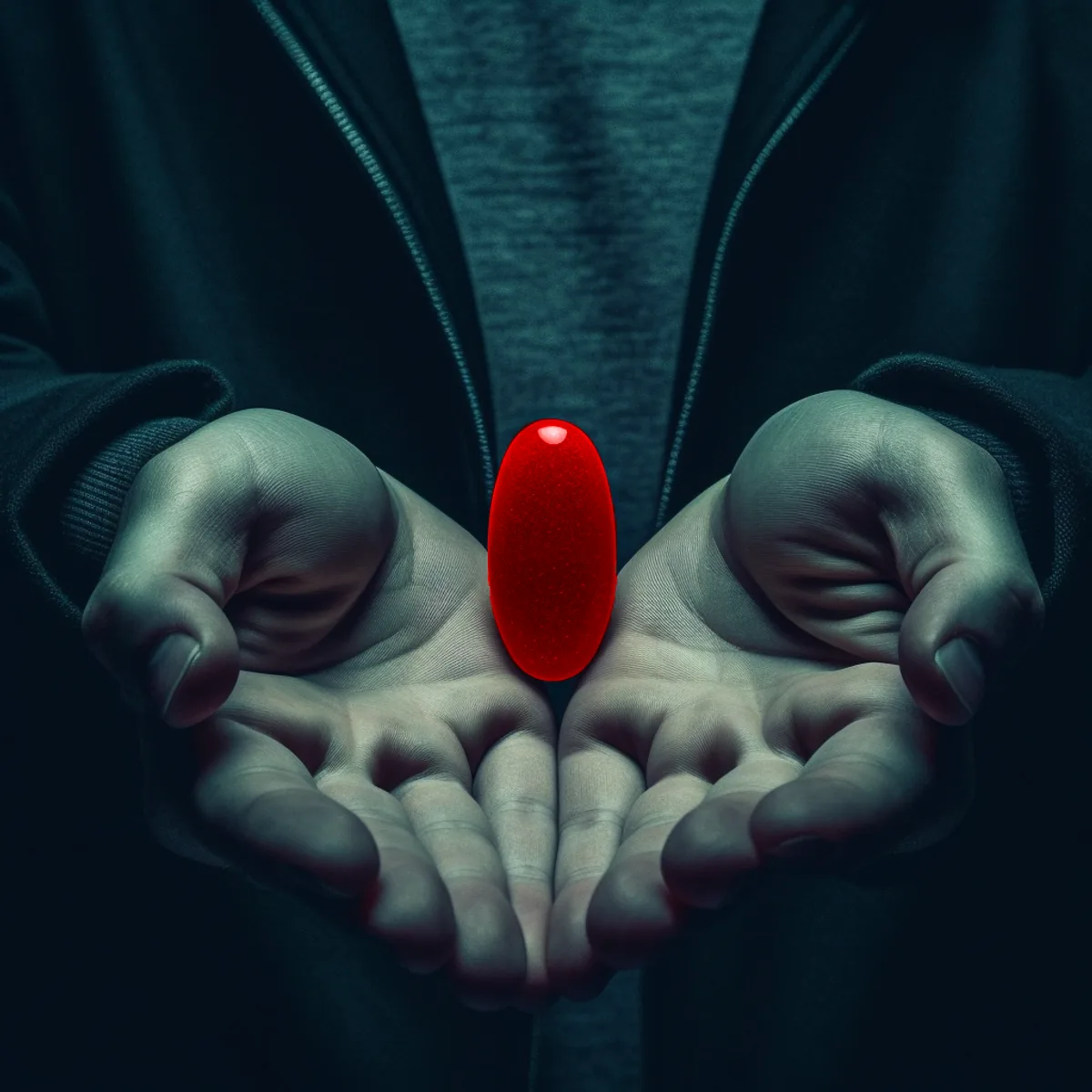
In The Matrix (1999, written and directed by the Wachowskis), Morpheus offers Neo two pills. The blue pill ends the conversation: Neo wakes up in his own bed and goes on believing whatever he likes. The red pill shows him what is actually there, however unwelcome. Red is the uncomfortable truth; blue is the comfortable illusion.
Outside the film, "taking the red pill" has come to mean choosing to see something as it really is, at some cost to your peace of mind, and "taking the blue pill" means choosing not to look. That is the whole of the meaning in ordinary use. The rest of this piece is about why the scene works so well, and why the choice is harder than it looks.
What happens in the red pill scene?
Neo is a programmer who has spent years with the feeling that something about the world is slightly off. Morpheus, who has been looking for him, meets him in a bare room during a storm and tells him that the feeling is correct, but that nobody can simply be told what the problem is. He has to see it.
So Morpheus holds out both hands. One pill in each. He is careful about the terms: he is offering only the truth, nothing more, and once the choice is made it cannot be unmade. The red pill, he says, will show Neo how deep the rabbit hole goes. Neo takes the red one. What follows is the rest of the film.
It is worth noticing what Morpheus does not do. He does not argue. He does not describe the truth in advance or promise that it will be pleasant. He makes the cost clear and leaves the decision where it belongs.
Why a red pill and a blue pill?
The colours do a lot of quiet work. Blue reads as calm, cool, sleep. Red reads as alarm, blood, waking up. You do not need to be told which pill is the safe one; your eye has already decided before the dialogue does.
The pill itself matters too. A pill is small, ordinary and irreversible once swallowed. It is a very undramatic object to carry such a large decision, which is exactly the point: the choices that change the shape of a life rarely announce themselves. They look like a small thing you could take or leave.
What does the rabbit hole have to do with it?
The film borrows openly from Lewis Carroll. Early on Neo is told to "follow the white rabbit", and shortly afterwards he does, following a woman with a white rabbit tattoo to the place where he will meet the people who find him. Morpheus compares him to Alice tumbling down the rabbit hole, and the red pill is his way into Wonderland.
The borrowing is apt. Alice's world is not a lie, exactly; it is a world with different rules, which make perfect sense once you stop insisting on the old ones. The rabbit hole is the point after which you cannot reason your way back to where you started. Our glossary uses the phrase in roughly that sense.
How did "red pill" enter everyday speech?
Partly because the film was enormously influential, and partly because the image is so economical. Before 1999 there was no tidy way to say "I would rather know, even if knowing is worse". Afterwards there were two words for it, and a picture everyone recognised.
In ordinary conversation you will hear it used in small, unremarkable ways. Someone looks properly at their spending for the first time and calls it a red-pill moment. A team stops reporting the flattering metric and starts reporting the honest one. A writer reads their draft aloud and hears what it actually sounds like. In each case the phrase means the same thing it meant in the film: the comfortable version is gone, and what remains is more useful.
The blue pill is used just as often, usually about oneself and usually a little ruefully. Not opening a letter you know contains bad news is a blue-pill decision. So is deciding not to check how long the thing you have been putting off would actually take.
Has the phrase been used in other ways?
Yes. In later years the phrase was adopted by a number of online communities, across quite different and sometimes opposing political positions, each using it to describe their own idea of an awakening. Those uses are not what the film was about, and they are not what we mean by it. On this site, the red pill means only what it meant in the 1999 film: choosing to see what is there rather than what is comfortable.
Is the red pill always the right choice?
The film is more honest about this than its reputation suggests. Not everyone who took the red pill is glad they did. One character in particular comes to regret it, and the film lets that regret be understandable rather than simply wrong. Reality, once seen, is harder and colder than the illusion was. The film never pretends otherwise.
So the meaning is not "truth makes you happy". It is closer to this: a true picture is the only one you can actually act on. A comfortable picture is pleasant to live in and useless to plan from. You can choose comfort, and many reasonable people do, about many things. But you cannot choose comfort and accuracy at the same time.
That distinction turns out to apply to a lot of ordinary life. It applies, for example, to how long you think your reading takes — most people guess, and the guess is usually flattering. The reading speed test is a very small red pill in that sense: three minutes, and you have a real number instead of a story. We wrote about what the number means in How to read faster.
Why is a book shop named after the pills?
Because the most common blue pill is the description you give of yourself. Ask someone how they work and you get the settled version: the one they have repeated at interviews and in their own head for years. It is not dishonest. It is simply the comfortable account, and it is often quite far from how they actually move when nobody is asking.
Most advice is written to that account, or to an average of everyone's accounts, which is part of why the self-help book you finished changed nothing. The red pill, in our sense, is looking instead at what you do: what you choose in a situation you have never been asked about, where there is no rehearsed answer to give. That is the method behind the scenes, explained in What is kokology?.
It is a modest version of the film's choice. Nobody wakes up in a pod. But the structure is the same: you are offered a look at the shape you actually have, with no promise that it will flatter you, and you decide whether to take it.
What should you take from the scene?
- The choice is about information, not identity. Morpheus offers Neo a fact, not a new self. What Neo does with it is up to him.
- The cost is stated up front. A fair red pill tells you it might be unwelcome. Anything that promises the truth will also feel good is selling something else.
- There is no going back, and that is fine. Once you have seen a real number — how long a book takes you, where the money goes, how you actually decide — the old estimate stops being available. That is the point of looking.
- Comfort is a legitimate choice. The film does not sneer at it. It just will not pretend that comfort and accuracy are the same thing.
If you want to try the small version, the twenty-one scenes at /personalise take about eight minutes and ask what you would do, never what you believe about yourself. You see the reading before you are asked to pay. The books written from it are short, personal and built around how you actually move — which is the only kind of red pill we know how to offer.
Technology
Have Master of Technology written for the way you move.
Twenty-one scenes, about eight minutes, no account needed. You see your reading and your contents page before you pay.